BIOREGIONAL DEVELOPMENT HEMP RESEARCH
In the latest issue (Vol. 11 #2) of the Journal of Industrial Hemp, Sue Riddlestone and Emily Stott, both affiliated with BioRegional Development, and Kim Blackburn and James Brighton of Cranfield University, discuss their research on green decortication. A short preamble gives a history of similar research and then leads into their own work, much of which is based on a hemp crop raised in Battle, East Sussex in 2003. That study was funded by the UK government under the England Development Programme, the European Agricultural Guidance, the Guarantee Fund and OFIC. Support was also given by SEEDA, WWF, Marks and Spencer, The Poldham Puckham Charitable Foundation and The Wyndham Charitable Trust.
The UK company Hemcore grew 1 1/2 acres using Fedora 17 and Chameleon, seeded at the rate of 55kg/ha. From these studies, it was easily seen that Chameleon had a higher fibre content (33.8% vs. 26.1% mean), but a similar hurd content. Chameleon also had a higher number of plants, which were on average smaller. A mean raw moisture content for both was recorded to be 72%. Both varieties yielded more than expected (based on recent reports by Struik/Bocsa and Karus) dry matter, with Chameleon weighing in at 15.1 t/ha and Fedora, 17.2 t/ha, though different accounting and harvesting techniques may have been responsible for this difference.
Other differences noted were the strength of the stems, with Fedora evincing more lignification, and the smell, with Fedora noted for putting forth a strong smelling odour from the oil glands.
Fibrenova assisted in the decortication process, along with Hi-Tech International. Three pilot-scale machines with three different functions which replicate the process of a full-scale harvester were made available.
A second trial was held in New South Wales in 2004, in which different machinery was used, and third hemp variety, CHG, of Chinese stock, was grown by Phil Warner of EcoFibre Ltd in conjunction with Keith Bolton from Southern Cross University. The CHG variety also rendered a lower percentage of fibre than Chameleon.
One aspect of both trials is the high levels of moisture in green hemp (up to 77%), and drying the plants was a large part of the work. Sun drying and wringing out the stems by machine were two methods utilised. One reason for drying the fibre is to reduce the weight for transport, which can add prohibitively to the cost of development.
Since this study, BioRegional has conducted a third trial, in Rochford, Essex, with 10 acres planted with three varieties; however, data from this was not available at the time so this is expected to appear in a subsequent issue.
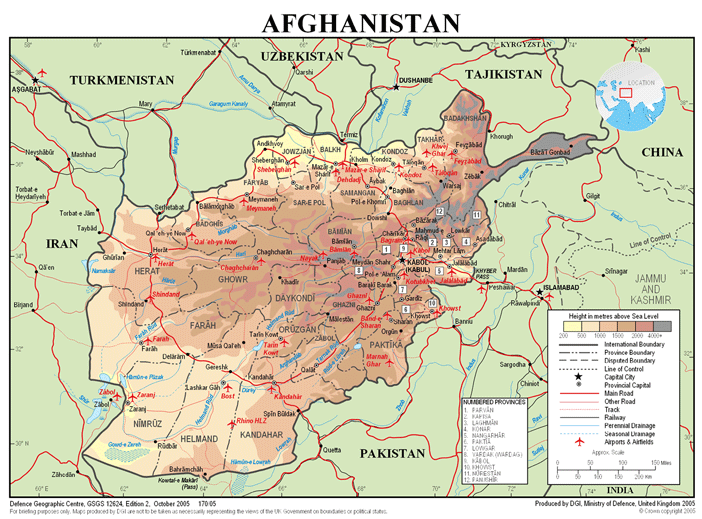
The UK is at present investigating the use of hemp for many reasons, although the revival of a UK hemp textile industry is a difficult undertaking, especially as the UK has ceased to be a textile producing nation. The majority of hemp textiles are manufactured in China at present. However, there are economic and ecological reasons to pursue this research in other areas, including the development of a hemp industry in troubled regions, such as Afghanistan, where it could well replace the opium poppy.
BioRegional's research is at the cutting edge, and will no doubt be used to a large degree in the near future as the hemp industry worldwide increases. According to Riddlestone and her colleagues, world total consumption of textile fibres stands at ca. 56m tonnes (for 2003), of which cotton accounted for 19.5m tonnes, and polyester staple fiber 9.25m tonnes. Flax production was roughly 250,000 tonnes, and hemp was but 70,000 tonnes.
 THE FLYING COLOURS OF HEMP