Showing posts with label retting. Show all posts

Monday, January 07, 2008


HEMP IN NEPAL

The Journal of Industrial Hemp, Vol 12 #2 (2007) is another goldmine of information - contents are in the previous post. Two of the articles are on Nepal, both by the globetrotting hempologist Robert C. Clarke. His latest adventures took him to Kathmandu and from whence the young man went west, to the westernmost district, Darchula. In that region hemp (nena in the Tamang language) is grown at altitudes of 1,500-3,000m. He asserts that Darchula produces the highest quality hemp textiles.

Of interest is the fact that they are able to harvest the crop for resin, seed and textiles - most Western countries are using a single purpose crop. There is also the use of the hurds as torches, so one could say there are four uses made of the plant.

The textile and cordage obtained from the outer bark is also produced locally, with about 3,000 r0lls a year sold on the Kathmandu; it is estimated that the same amount stays in the region.

Clarke notes that legally this is prohibited, and this I was able to confirm in a conversation with Udaya Thapa, a Ghurka who is very active in the hemp industry in Nepal. Thapa noted, however, that wild hemp could be harvested, and this same law applies in the US - with the stipulation that the leaves be fallen off first. The Lakota Indians have worked within the law there and used feral hemp to produce paper, but have had their harvests of hemp destroyed by the US government. The influence of which is very pernicious, and may well be responsible for the law in Nepal which does not differentiate between industrial hemp and marijuana.

Somewhat unique to Asian hemp culture is the Darchula practice of beating the stalks to loosen the hurd from the bast. After this the stalks are boiled for an hour, cooled, rinsed in flowing water, beaten, dried and beaten again. The practice of today is not much different than that of 1855, as observed by H.B. Hodgson:

After the plants have been cut off at the ground, they must be placed in the sun for 8-10 days, or until they be dried sufficiently. They must then be steeped in water [retted] for three days, and on the fourth day the plants must be taken out of the water and peeled. The peelings are to be washed and placed in the sun; and when quite dried, they are ready for manipulation. They are then to be torn into threads with the nails of the hands; next twisted with a spinning wheel (tikuli), and when the threads are thus prepared, they are to be boiled with ashes of wood and water in a pot, for four hours, and to be washed again for the purpose of whitening. This is the way of preparing bhangela [sic] thread, out of which blankets are woven.

Nepal's neighbours India and China do grow and have grown hemp. Currently China sells the most and perhaps at the cheapest price. As hemp is in more and more demand, and governments realise that they cannot sustain the water intensive cotton industry anymore, they will be happy to have hemp on hand. Just watch out for any maniacs with Agent Orange in US helicopters.

Thursday, September 07, 2006


HEMP IN KOREA

A recent article in the Journal of Industrial Hemp, vol. 11, # 1 [2006], written by Robert C. Clarke, gives us a fascinating look at hemp in Korea, mainly South Korea/Republic of Korea.

Production levels are much less than what they were in the past, but cultivation and processing still go on, to an extent, mainly in the Andong, Boseong, Jeongseon, Geochang, Muju and Gokseong regions.

As recently as 1963, hemp (known as sambe) was grown in every province, although 82% or more was grown in the above mentioned regions.

Whilst there is no mention of hemp having ever been totally outlawed, Clarke states that hemp gorwers must now have a government permit. Landraces are entirely dioecious, moderately branched and reach 8-13' (2.5-4.0m) in height at maturity, with a lower seed yield than European varities. Some taxonomists consider Korean and other Asian broad-leafed hemp varieties to be a seperate species. Herbicides and pesticides are rarely used, although there is an 1960s record of 0.1% Endrin sparying used to control stem borers. At present, only one pest is deemed to cause economic damage, the hemp flea beetle.

Fibre yields are 1-1.4 tons/hectare (bast fibre only, dry, processed weight). A unique method of processing hemp fibre in Korea is steaming, which Clarke notes to be "faster, more controllable and less polluting than water retting in open ponds." Traditional steaming cabinets are heated from below, using brush and hemp hurds from the previous harvest. After steaming and and hour of cooling, the wet fibres are removed by hand.

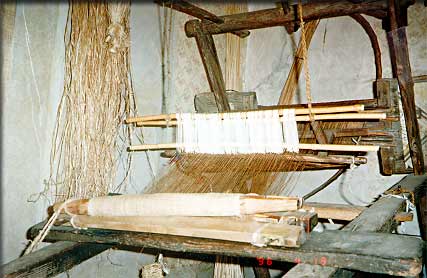
Most of the work, including scutching (carried out with a blunt knife called a sam top) and weaving are carried out by hand. (Above is an image of a Korean loom used for weaving).

The hemp industry is seen as a part of the culture and is thus encouraged, with hemp weaving designated an Intangible Cultural Asset No. 1 in the Andong City District, and ICA No. 32 in the Jeollanam Province. Nonetheless, foreign competition, mostly from China, has placed great strain on the market, and some Korean hemp enterprises have been forced to close their doors.

Saturday, July 08, 2006

PECTIN
Pectin is a heterosaccharide, found in the cell wall of plants. The term 'pectin' includes a number of compounds which vary in the order of the monosaccharides. Under acidic conditions, it forms a gel, most well known from its use in marmalade and other jams. In fruit it is a welcome ingredient, which breaks down during maturation to pectinic and pectic acids in the presence of the enzyme pectinose. In general, hard fruits contain more pectin than soft fruits.
In fibre plants, pectin is removed out of necessity so as to isolate the cellulose, which is the main compound in paper and textiles. Hot water is one way of removing pectin, which is why hot-water retting and boiling have been methods of the hemp farmer.
Today hot-water retting is being explored along with enzyme retting. The goal of researchers is the removal of pectin from the stem so as to produce a pure cellulose fibre, free from pectin and other substances, such as lignin.