Showing posts with label Hempcrete. Show all posts

Friday, July 10, 2015

New York Times article on Hemp 7 July 2015

STUYVESANT, N.Y. — It started with Hurricane Katrina: the flooded houses in New Orleans festering with mold, many uninhabitable to this day. Then came the earthquake in Haiti: thousands dead, crushed by homes that should have been their sanctuaries.
James Savage, then a Wall Street analyst living on Central Park West, grew disturbed about the conditions he saw on television and in the newspapers.
“There has to be something better we can do than this,” he recalled thinking last week as he sat at the kitchen table inside his new home here on a cliff overlooking the Hudson River 120 miles north of New York City.
The solution he has come up with is not some space-age polymer or recycled composite but a material that has been in use for millenniums, though it is more often demonized than venerated on these shores.
“Who knew hemp would be the answer to what we were looking for?” said Mr. Savage, who started a company to create building materials derived from cannabis.
Now that the forbidden plant is enjoying mainstream acceptance, Mr. Savage is hoping to put hemp to use not in joints but between joists. His first project has been his own 1850s farmhouse, though he says he believes hemp-based building materials can transform both agriculture and construction throughout New York.
Photo
Hemp chips, from the balsalike interior of the cannabis plant. CreditPreston Schlebusch for The New York Times
While cannabis has had a long history as a fiber used in ropes, sails and paper products — Presidents Washington and Jefferson both grew it — Mr. Savage is among a small number of entrepreneurs who have instead turned to a novel application known as hempcrete.
Hempcrete is made using the woody, balsalike interior of the Cannabis sativa plant (the fiber for textiles comes from the outer portion of the stalk) combined with lime and water. Though it lacks the structural stability its name might suggest, hempcrete does provide natural insulation that is airtight yet breathable and flexible. It is free from toxins, impervious to mold and pests, and virtually fireproof.
“I know, I know, everyone talks about our buildings going up in smoke, but the joke is on them,” Mr. Savage said. In England, some insurers actually provide a discount for hempcrete because of its durability.
And because the material is grown rather than mined, like traditional cement, or manufactured, like fiberglass, it gives new meaning to green building. Mr. Savage envisions a “hemp basket” stretching across New York’s rugged farmlands supplying locally sourced insulation throughout the Northeast.
What hemp is not, as advocates constantly remind people, is a drug.
“You could smoke a telephone pole’s worth of our stuff and still not get high,” said Ken Anderson, whose company, Original Green Distribution, based in Minneapolis, makes a hempcrete marketed as Hempstone.
The strain of plant grown for hempcrete contains no more than 0.3 percent of THC, the active ingredient in marijuana. That is compared with 5 to 10 percent found in the hallucinogenic and medicinal varieties.
Photo
Bagged hemp chips in Mr. Savage's basement. CreditPreston Schlebusch for The New York Times
“It’s like the difference between a wolf and a poodle,” Mr. Savage said. “Same species, totally different animal.” Even so, both strains were outlawed starting in the 1930s.
Mr. Savage hardly looks the part of a hemp evangelist. He favors polos to tie-dye T-shirts and drives an Audi sedan.
“Did I smoke grass when I was young?” he said, standing beside a poster for the original Woodstock concert. “Sure, I did, but it wasn’t like I was looking for a way to make money off hemp. It just happened to be the thing with all the attributes we were looking for in a building material.”
He came upon hempcrete through a simple Internet search.
The material was developed in the 1980s in France, though it has roots going back centuries not only to homes as far away as Japan but also to Merovingian bridges in ancient Gaul.
Hempcrete has since caught on across Europe, where hemp cultivation was never criminalized. Hundreds of buildings now use hempcrete, including a seven-story office tower in France, a Marks and Spencer department store in the United Kingdom, and even a home built by Prince Charles.
Though the illicit aspects of hemp may have held it back in this country, marijuana’s growing popularity could finally be helping hemp’s spread. “Some people thought hemp might help get marijuana accepted, but it’s going the other way around,” said Eric Steenstra, executive director of the Hemp Industries Association. “I don’t think you’d see quite the same excitement if we were building with flax or jute.”
Photo
The chips are mixed with lime and turned into a paste that is dried to make hempcrete insulation.CreditPreston Schlebusch for The New York Times
Yet federal regulators remain dubious, with virtually no domestic hemp production. It is legal to use it, but generally not to grow it. The farm bill passed last year began to allow for hemp-farming pilot projects, and while New York and Connecticut have both begun programs, no crops have been planted. At the moment, all raw material must be imported, and last year Canada alone shipped $600 million of hemp to American businesses.
A bigger hurdle may be getting hemp-lined homes past building inspectors.
“If you show them two-by-fours filled with fiberglass, they know what they’re dealing with,” said Tim Callahan, an architect in Asheville, N.C., “but you mention hemp, and they scratch their heads.” He has worked on about a dozen hempcrete structures, including what is thought to be the first home in this country to use hempcrete, built in 2010.
Yet hempcrete presents its own issues, particularly the need for thicker insulation than traditional materials.
Even in Brooklyn, where it would seem a natural fit, hempcrete has been a tough sell for Gennaro Brooks-Church, a contractor who specializes in green building. “When a client is spending $2 million on a brownstone and sinking in another $1.5 million on renovations, you’ll be hard pressed to get them to sacrifice even an inch of space,” he said.
For his part, Mr. Savage was never able to bring his product to Haiti — he blames Haitian fears of United States law enforcement — and an effort in Mali failed because of a 2012 coup. Around that time, the first marijuana decriminalization laws began to pass in the United States, so he turned his focus closer to home.
To foster wider acceptability, Mr. Savage and his three-year-old business, Green Bui lt, which he runs out of his hemp-lined home office, is working toward developing a panelized system. Akin to drywall, it would be easier to market and install than poured hempcrete, he said. And, combining housing trends, he is developing a 400-square-foot “tiny house” made up of two or three circular, shippable hempcrete modules.
His only project so far has been turning his red brick farmhouse into a hempcrete laboratory, where many of the walls have been insulated with it, eliminating his need for air-conditioning.
Mr. Savage said his hemp rooms even smell different, though not the way most people might expect. “It has a freshness to it,” he said.

Monday, October 27, 2014

Progress for hemp in North Carolina


We have been following on this site states' progress in making hemp legal; there has been little progress, despite the federal ban being lifted. Mainly a handful of southern and western states are fighting for their rights. This just in from North Carolina:           
 
Posted: Thursday, October 23, 2014 12:27 am | Updated: 12:29 am, Thu Oct 23, 2014.
NC State students are advocating for the legalization of hemp, arguing that the misunderstood dichotomy between hemp and marijuana has inhibited the U.S.A. from receiving the benefits from mass-producing hemp. 
The Raleigh Hemp Society screened the award-winning documentary, “Bringing It Home,” which emphasizes the benefits that hemp can have on our society and the struggle to get it legalized in the US on Sunday in the Witherspoon Student Cinema.
About 30 students attended the screening to hear the film’s message that hemp’s benefits are being ignored by American society due to the fundamental mischaracterization that the hemp plant is the same as recreational marijuana. 
“You can smoke a field of hemp, and you would die of CO2 poisoning before you got high,” said Andrew Klein, a senior in natural resources policy and administration and founder of the Raleigh Hemp Society. “Hemp and marijuana are both cannabis sativa, but the point is that they are completely different. It’s like comparing a house cat to a lion.” 
The documentary presented one of the Drug Enforcement Administration’a (DEA), arguments against hemp, stating recreational marijuana can be hidden among hemp stalks because the plants look similar.
Hemp supporters, however, argue this is unlikely due to the special, climate-controlled conditions needed to produce “smoker’s” marijuana.
Hemp is widely produced in 31 other industrial countries including France, China and the U.K. 
The THC content of industrial hemp is 0.3 percent or lower, which, according to the documentary, is too low a level to be psychoactive in the body. It is significantly less than the THC content found in recreational cannabis, which stands at about 40 percent.
Historically, this misconception has been a major factor in hemp’s illegal status in the U.S., dating back to 1970 when President Richard Nixon first declared it a Class I drug along with recreational marijuana and heroin, among others.
While interning for the Virginia Hemp Company this past summer, Klein said he spent a significant amount of time lobbying in Washington D.C. where he ran into the problems with this misconception frequently. 
“I talked mostly with staffers, but most agriculture reps said that [the politicians they represent] are anti-marijuana,” Klein said. “This shows that, for many politicians, the fear of politically associating with marijuana keeps them from seeing the benefits of hemp.”
Before it was declared illegal, the U.S. government promoted hemp to help the U.S. win WWII with the “Hemp for Victory” propaganda campaign, which encouraged farmers to produce hemp to make rope, cloth and cordage for military use. Hemp was also the first material ever used to make cloth in 800 B.C. China, according to the documentary. 
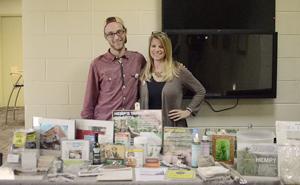
Klein and his staff members set up a table showing off some of the varied ways that hemp can not only provide a greener alternative to common products but even improve on them. The table had hemp cooking oil, which has more omega-3 than traditional oil, hemp paper, which can be produced four times more efficiently than paper from trees, the different hemp fibers used in clothing, which can be produced with less water than cotton, and raw hemp, which can be made into a concrete substitute. 
The use of hemp to make concrete, or “hempcrete,” has particularly interesting prospects for the U.S. as a whole, according to the documentary. 
Not only could it provide thousands of new jobs due to building renovations and new building construction, but it can improve quality of life for homeowners. 
According to the documentary, hempcrete is a carbon negative material, which means that it actually absorbs CO2 in the air as well as filters out other pollutants. The construction process could also made safer by the use of hempcrete, as it does not require workers to wear masks or gloves because it is nontoxic. Power tools would also be unnecessary when using hemp, which would eliminate loud noise and wires on construction sites. 
“Hempcrete wall construction is not complicated, but there is a learning curve in working with low temperatures and wet conditions,” Linda Booker said, co-producer, director and editor of “Bringing It Home.”
When Booker and her co-producer Blaire Johnson began filming in November 2010, Booker was new to the history of hemp.
In 2011, Booker and Johnson attended the Hemp Building Symposium in Granada, Spain where they were able to meet with global hemp business leaders which changed her perspective on this issue. 
“I was skeptical like a lot of people,” Booker said. “I realized that we need a good film to educate people about this.” 
President Barack Obama signed the Farm Bill in February, which made hemp legal for research and academic uses, which is a step towards legalization. However, hemp is still illegal to grow without a DEA issued permit. 
The DEA has only issued three of these permits since 1970, according to the documentary released in 2013.
“Until we take hemp out of the substance one narcotic classification, the DEA will still have jurisdiction over seed imports for research,” Booker said. 
Booker said DEA pressure forces higher prices for legal hemp products because they have to be imported. 
Andrew Klein said he is working to inform people about hemp close to home. 
“The future is working with businesses, farmers and political leaders to formulate policy to help legalize hemp in NC,” Klein said. “The long-term future of the hemp society is to get passionate, intelligent students jobs in the hemp markets.”  

Sunday, January 20, 2013

Houses of Hemp in America

This article, titled "House of hemp? Pushing cannabis as a

construction material" by Jeffrey Head appeared last year in

 latimesblogs.latimes.com
 
Hempcrete house Push Design


Woody Harrelson championed the environmental benefits of hemp. Giorgio Armani and Calvin Klein incorporated it into their collections. Now a company promoting hemp as the eco-building material of the moment said it wants to build California's first hemp house.
Knapp's Castle siteHemp Technologies said it wants to use hemp-based materials to construct a 500-square-foot structure at the ruins of Knapp's Castle near Santa Barbara. The castle, completed in 1920, was built for Union Carbide founder George Owen Knapp but destroyed by wildfire in 1940. Since then, all that has remained on the property are the sandstone blocks outlining the once-grand estate.
The principal material for the project is Hempcrete, made of the woody internal stem of the Cannabis sativa plant, which is processed into chips and mixed with a lime-based binder. That concoction is then sprayed on, poured into slabs or formed into blocks like concrete to create the shell of a building. Interior surfaces are plastered, and exterior surfaces are stuccoed.
“The walls are to be framed and earthquake-braced internally with lumber,” said Greg Flavall, Hemp Technologies' co-founder, who added that “hemp is very close in cellulosic value to wood.” The material helps to keep structures warm in winter and cool in summer, he said.

Other advantages, advocates have said, beyond the fact that the plant can be grown with little water and few pesticides: Hemp is resistant to fire damage and termites. Although air does not pass through the walls, moisture naturally dries out, and mold or dry rot are not problems. David Madera, who co-founded Asheville, N.C.-based Hemp Technologies with Flavall, credited the walls' lime content, which needs carbon dioxide to harden.
The lime will pull carbon dioxide from the environment after the home is built “because the lime wants to go back to being a rock,” Madera said. “That means the wall is going to get harder and harder over time.”
Flavall said the Knapp's Castle structure “will lock in about 12 tons of carbon dioxide that would otherwise have escaped into the atmosphere when the hemp cellulose decays in the field.”
That is, if the structure is completed. A Santa Barbara County official said a project has been submitted for planning approval but still needs to pass most stages of the permitting process. A house, outbuilding or any other structure would have to be deemed appropriate for the site, and any unconventional materials would have to be declared safe.
Madera, who declined to disclose the identity of his firm's California client, said Hemp Technologies has consulted on three Hempcrete houses in North Carolina, where the material was treated as an alternative form of insulation.
Although hemp contains only trace elements of tetrahydrocannabinol, or THC, the active ingredient in marijuana, hemp is still derived from a cannabis plant. State and federal laws do not make a distinction between varieties of cannabis used for clothing or building materials and varieties used for more psychoactive purposes, so producing hemp is prohibited. Importing hemp, however, is legal, and various companies are pushing forward with hemp building products too.
CannabricHemp Traders in L.A. distributes Hemp Board, a medium-density fiberboard (MDF) made from the same woody material that goes into Hempcrete. Hemp Board President Lawrence Serbin said his MDF is a sustainable alternative for doors, cabinets and shelves.
Spanish architect Monika Brümmer has developedCannabric and Cannapanel, which, as the names suggest, are cannabis-based building blocks and wall panels. She has completed several residential projects in her country, where the products met construction standards.
-- Jeffrey Head
Hempcrete house 2 Push Design
One of three Hempcrete houses in North Carolina designed by Push Design with Hemp Technologies providing hemp materials and serving as consultants.
Photos, from top: Another Hempcrete house in North Carolina. Credit: Push Design. The site of Knapp's Castle in Santa Barbara County. Credit: Pfly / Wikipedia Commons