Showing posts with label hemp petition. Show all posts

Monday, October 27, 2014

Progress for hemp in North Carolina


We have been following on this site states' progress in making hemp legal; there has been little progress, despite the federal ban being lifted. Mainly a handful of southern and western states are fighting for their rights. This just in from North Carolina:           
 
Posted: Thursday, October 23, 2014 12:27 am | Updated: 12:29 am, Thu Oct 23, 2014.
NC State students are advocating for the legalization of hemp, arguing that the misunderstood dichotomy between hemp and marijuana has inhibited the U.S.A. from receiving the benefits from mass-producing hemp. 
The Raleigh Hemp Society screened the award-winning documentary, “Bringing It Home,” which emphasizes the benefits that hemp can have on our society and the struggle to get it legalized in the US on Sunday in the Witherspoon Student Cinema.
About 30 students attended the screening to hear the film’s message that hemp’s benefits are being ignored by American society due to the fundamental mischaracterization that the hemp plant is the same as recreational marijuana. 
“You can smoke a field of hemp, and you would die of CO2 poisoning before you got high,” said Andrew Klein, a senior in natural resources policy and administration and founder of the Raleigh Hemp Society. “Hemp and marijuana are both cannabis sativa, but the point is that they are completely different. It’s like comparing a house cat to a lion.” 
The documentary presented one of the Drug Enforcement Administration’a (DEA), arguments against hemp, stating recreational marijuana can be hidden among hemp stalks because the plants look similar.
Hemp supporters, however, argue this is unlikely due to the special, climate-controlled conditions needed to produce “smoker’s” marijuana.
Hemp is widely produced in 31 other industrial countries including France, China and the U.K. 
The THC content of industrial hemp is 0.3 percent or lower, which, according to the documentary, is too low a level to be psychoactive in the body. It is significantly less than the THC content found in recreational cannabis, which stands at about 40 percent.
Historically, this misconception has been a major factor in hemp’s illegal status in the U.S., dating back to 1970 when President Richard Nixon first declared it a Class I drug along with recreational marijuana and heroin, among others.
While interning for the Virginia Hemp Company this past summer, Klein said he spent a significant amount of time lobbying in Washington D.C. where he ran into the problems with this misconception frequently. 
“I talked mostly with staffers, but most agriculture reps said that [the politicians they represent] are anti-marijuana,” Klein said. “This shows that, for many politicians, the fear of politically associating with marijuana keeps them from seeing the benefits of hemp.”
Before it was declared illegal, the U.S. government promoted hemp to help the U.S. win WWII with the “Hemp for Victory” propaganda campaign, which encouraged farmers to produce hemp to make rope, cloth and cordage for military use. Hemp was also the first material ever used to make cloth in 800 B.C. China, according to the documentary. 
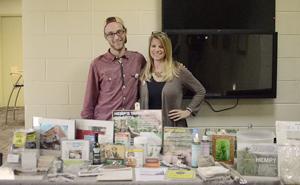
Klein and his staff members set up a table showing off some of the varied ways that hemp can not only provide a greener alternative to common products but even improve on them. The table had hemp cooking oil, which has more omega-3 than traditional oil, hemp paper, which can be produced four times more efficiently than paper from trees, the different hemp fibers used in clothing, which can be produced with less water than cotton, and raw hemp, which can be made into a concrete substitute. 
The use of hemp to make concrete, or “hempcrete,” has particularly interesting prospects for the U.S. as a whole, according to the documentary. 
Not only could it provide thousands of new jobs due to building renovations and new building construction, but it can improve quality of life for homeowners. 
According to the documentary, hempcrete is a carbon negative material, which means that it actually absorbs CO2 in the air as well as filters out other pollutants. The construction process could also made safer by the use of hempcrete, as it does not require workers to wear masks or gloves because it is nontoxic. Power tools would also be unnecessary when using hemp, which would eliminate loud noise and wires on construction sites. 
“Hempcrete wall construction is not complicated, but there is a learning curve in working with low temperatures and wet conditions,” Linda Booker said, co-producer, director and editor of “Bringing It Home.”
When Booker and her co-producer Blaire Johnson began filming in November 2010, Booker was new to the history of hemp.
In 2011, Booker and Johnson attended the Hemp Building Symposium in Granada, Spain where they were able to meet with global hemp business leaders which changed her perspective on this issue. 
“I was skeptical like a lot of people,” Booker said. “I realized that we need a good film to educate people about this.” 
President Barack Obama signed the Farm Bill in February, which made hemp legal for research and academic uses, which is a step towards legalization. However, hemp is still illegal to grow without a DEA issued permit. 
The DEA has only issued three of these permits since 1970, according to the documentary released in 2013.
“Until we take hemp out of the substance one narcotic classification, the DEA will still have jurisdiction over seed imports for research,” Booker said. 
Booker said DEA pressure forces higher prices for legal hemp products because they have to be imported. 
Andrew Klein said he is working to inform people about hemp close to home. 
“The future is working with businesses, farmers and political leaders to formulate policy to help legalize hemp in NC,” Klein said. “The long-term future of the hemp society is to get passionate, intelligent students jobs in the hemp markets.”  

Tuesday, March 26, 2013

Last minute compomise possible for Kentucky bill

The struggle for hemp in Kentucky appears to have reached some kind of compromise, as Scott
Wartman in the Cincinnati Enquirer notes in bold below. There is mention of the federal ban, which the state hopes will be lifted - or a waiver for the state - what kind of lobbying is in place for this is not clear, but if this is an option it might be worth noting for others states - Colorado, for instance, has already made hemp legal but is under constraint with the federal ban. While this is all in the works, it is well worth signing the petition to the White House to have the ban lifted for all 50 states - www.minawear.com/about-us/ 


The bill that would establish regulations for an industrial hemp industry in Kentucky appears alive on the final day of the General Assembly.
House Majority Floor Leader Rocky Adkins, D-Sandy Hook, said he’s met with Sen. Paul Hornback,R-Shelbyville, who sponsored the bill, and others to reach an agreement on the bill that would pave the way for an industrial hemp industry in Kentucky should the federal government lift its ban on the crop or give Kentucky a waiver.
Adkins has pushed for a regulatory framework that includes more research of industrial hemp, administrative regulations enforced by the Department of Agriculture and law enforcement background checks for those growing hemp.
“The collaboration between those three components, in my opinion, makes the regulatory framework stronger and gives us the opportunity to be looked at seriously when we do sen an application in asking for a waiver,” Adkins said.

Sunday, February 03, 2013

Qoutes on hemp from US presidents

I just looked at the petition at www.minawear.com/about-us and saw we had reached a milestone of 750 signatures, with a new goal of 1,000. The ulitmate goal is to get 25,000. The it goes to the President. Signer #750, Samsun from Berkeley CA, left 5 quotes from former presidents about hemp.

“Make the most you can of the Indian Hemp seed and sow it everywhere.”
 – George Washington
“Hemp is of first necessity to the wealth & protection of the country.”
– Thomas Jefferson
“Two of my favorite things are sitting on my front porch smoking a pipe of sweet hemp, and playing my Hohner harmonica.”
– Abraham Lincoln
“We shall, by and by, want a world of hemp more for our own consumption.”
 – John Adams
“The greatest service which can be rendered any country is the add a useful plant to its culture!”
  -Thomas Jefferson

Friday, February 01, 2013

Clinton welcomes news of Mitch McConnell backing hemp

Here is an article by Jason Hibbs of WPSD about a small town in Kentucky that is welcoming the news about the most powerful senator in the nation, their very own Mitch McConnell, supporting hemp. This news is going somewhat viral at the moment, it has of course hit the Huffington Post where the uber liberals are reviling POTUS over the fact that this issue is being championed by the likes of Dr Ron Paul, Senator Rand Paul, North Dakota State House Majority Leader Dave Monson, and now Mitch McConnell - all of whom are GOP derechistas.
marijuana ky 300FRANKFORT, Ky. (1/31/13) – Today, Senate Republican Leader Mitch McConnell issued a statement of support for Agriculture Commissioner James Comer and the effort to re-introduce industrial hemp into Kentucky agriculture. Leader McConnell’s office issued the following statement:
POTUS will be seeing the petition from Mina Hegaard of Texas, who was in Dr Ron Paul's district until this year - go there, whether you are GOP derechist, left winger or just a sensible person doing the right, I mean, correct thing - www.minawear.com/about-us/


CLINTON, Ky. - The growing debate over hemp legalization just got an endorsement from a very powerful ally.

Thursday, Senate Republican Leader Mitch McConnell jumped on board saying he supports re-introducing industrial hemp into Kentucky agriculture. A handful of lawmakers from both parties are backing a bill that would make Kentucky one of the first states to grow hemp.
One leader in the City of Clinton, wants his town to cash in on this form of cannabis before anyone else. He created a resolution to make it official that the City of Clinton supports the "alternative crop." At last month's commission meeting, leaders postponed the decision. On Monday, however, they'll likely take a stand on an issue that makes local law enforcement and neighbors nervous.

When people in Clinton hear the word "hemp," marijuana comes to mind. It even looks like weed, which is what worries Hickman County Sheriff Mark Green.

"If it looks like marijuana, how are we going to be able to tell the difference, I don't know if we can," Green said.

Clinton commissioner Ivan Potter started the discussion with a resolution. A statement that Potter says could turn Clinton into a thriving town.

"It would be a cash crop, number one, but it would also mean jobs for our people here who don't have jobs," Potter said.

Potter said hemp would breath life into old buildings like a former shoe plant that, at one time, employed more than 300 people.

But Sheriff Green worries legalizing hemp would make fighting the war on drugs even harder.

"Until they can prove to me it's not going to hurt law enforcement, I'm not going to back it," Green said.

Potter said harvesting hemp won't hurt anything. In fact, he says it's exactly what Clinton needs.

"It's gotten a bad wrap, let's just say it's cousin marijuana is a bad, bad boy, hemp is not like that," Potter said.

The Kentucky Department of Agriculture, which supports industrial hemp, said you cannot get high from industrial hemp and that the product is basically free of T.H.C., the intoxicating chemical found in marijuana.
Hemp can be used to manufacture fuel, clothing, paper, cosmetics, and other products.
The Kentucky Department of Agriculture says hemp is a nightmare for marijuana because it cross pollinates and actually destroys marijuana plants in the vicinity. Also hemp plants are much taller than marijuana plants.
Clinton commissioners will vote on the resolution Monday.

Most powerful senator in the US, Mitch McConnell, backs hemp

Yesterday I posted the speculation about Senator Mitch McConnell, the most powerful senator in the United States, throwing his hat in the ring for hemp. Today it is in. That means Kentucky has both of its senators supporting the movement, that is one big milestone, just after Mina and her pals got that petition up at www.minawear.com/about-us/ - we need to lobby from all sides and get this done!
This latest came about by the hard work of Kaite Moyer and the Kentucky Hemp Coalition - see their blog at:
www.kentuckyhempcoalition.blogspot.com
The article below is by Elahe Izadi of the National Journal:

Mitch McConnell Wants to See the Hemp Ban Go Up in Smoke

Senate Republican leader says hemp production would create jobs, not encourage illegal drug use.                                               


A hemp harvest in Switzerland. (AP Photo/fls/Keystone).
The titans of the budding hemp industry just got another supporter, and a powerful one at that: Senate Minority Leader Mitch McConnell.
It turns out some long talks with his libertarian-minded colleague Rand Paul have led to McConnell’s coming out in favor of industrialized hemp.
In a statement issued Friday, McConnell said, “I am convinced that allowing [hemp] production will be a positive development for Kentucky’s farm families and economy.” He also said he’s been assured by Kentucky Agriculture Commissioner James Comer that legalizing hemp production wouldn't promote illegal drug use.
“The utilization of hemp to produce everything from clothing to paper is real and if there is a capacity to center a new domestic industry in Kentucky that will create jobs in these difficult economic times, that sounds like a good thing to me,” McConnell said.
If industrial hemp were to be legalized in Kentucky, it could be a cash crop. Kentucky's Legislature is preparing to tackle the issue (law enforcement isn't a fan of legalizing industrial hemp production). Paul has also sponsored a bill that would lift the federal ban on growing hemp.