Saturday, February 16, 2008

Thursday, October 25, 2007

AB 684
After passing the California state senate on September 11 by a large majority (26-13), the bill to allow hemp in the Golden State was vetoed by the son of a Nazi whore some 33 days later. And I'm not speaking about his mother - his dad wore the bent cross in service to Hitler as an officer of the Reich.
Once again the will of the people has been subverted by the perverted. As the bill for the invasion of Iraq and Afghanistan now surpasses that of the bill for the Korean and Vietnam wars, 1 trillion bucks to be exact, people are beginning to get a little upset about the rip-off occuring in the Homeland. Some time ago Congresswoman Cynthia McKinney asked Donald Rumsfeld where 2.3 trillion bucks went at the Pentagon, and she is still waiting for an answer.
Now that she is considering a run for the Oval Office on the Green Party ticket, we may get an answer, and some action on legalising hemp. McKinney is aware that the first US flag was made of hemp, and that hemp is part of US history - so much so that the government issued a "Hemp for Victory" film in WWII. So where is the victory? Certainly Schwarzenegger has not delivered a sieg. Maybe more a state of siege.
Speaking of flags and victories, the US won a battle at sea against the Koreans in the late 19th century and confiscated the flag, which was, like the Betsy Ross stars'n'stripes, made of hemp. It is now on loan to Korea, which is hoping to get it back permanently. They want their hemp back and I don't blame them. Hopefully, Californians can also get their hemp back.
Thursday, September 07, 2006

HEMP IN KOREA
A recent article in the Journal of Industrial Hemp, vol. 11, # 1 [2006], written by Robert C. Clarke, gives us a fascinating look at hemp in Korea, mainly South Korea/Republic of Korea.
Production levels are much less than what they were in the past, but cultivation and processing still go on, to an extent, mainly in the Andong, Boseong, Jeongseon, Geochang, Muju and Gokseong regions.
As recently as 1963, hemp (known as sambe) was grown in every province, although 82% or more was grown in the above mentioned regions.
Whilst there is no mention of hemp having ever been totally outlawed, Clarke states that hemp gorwers must now have a government permit. Landraces are entirely dioecious, moderately branched and reach 8-13' (2.5-4.0m) in height at maturity, with a lower seed yield than European varities. Some taxonomists consider Korean and other Asian broad-leafed hemp varieties to be a seperate species. Herbicides and pesticides are rarely used, although there is an 1960s record of 0.1% Endrin sparying used to control stem borers. At present, only one pest is deemed to cause economic damage, the hemp flea beetle.
Fibre yields are 1-1.4 tons/hectare (bast fibre only, dry, processed weight). A unique method of processing hemp fibre in Korea is steaming, which Clarke notes to be "faster, more controllable and less polluting than water retting in open ponds." Traditional steaming cabinets are heated from below, using brush and hemp hurds from the previous harvest. After steaming and and hour of cooling, the wet fibres are removed by hand.
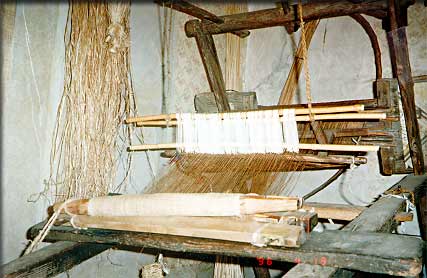
Most of the work, including scutching (carried out with a blunt knife called a sam top) and weaving are carried out by hand. (Above is an image of a Korean loom used for weaving).
The hemp industry is seen as a part of the culture and is thus encouraged, with hemp weaving designated an Intangible Cultural Asset No. 1 in the Andong City District, and ICA No. 32 in the Jeollanam Province. Nonetheless, foreign competition, mostly from China, has placed great strain on the market, and some Korean hemp enterprises have been forced to close their doors.