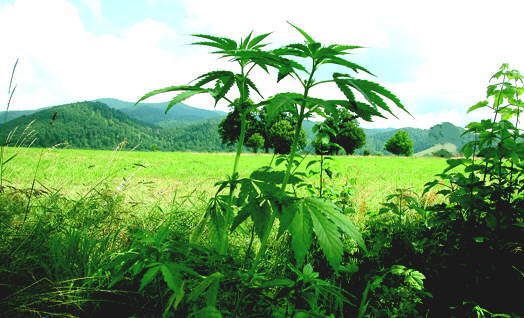
This website is an extension of the book "Hemp for Victory: History and Qualities of the World's Most Useful Plant." [ISBN 0-9549939-0-X, London, Whitaker Publishing, 2006. Ordering information: info@whitakerpublishing.co.uk/www.whitakerpublishing.co.uk] On this site will be found excerpts from the book along with updates, posted in the aim of giving the hemp world the latest information on the growth of the hemp movement.
Jonathan Berr on MSN Money reports on a new twist in the medical marijuana debate - cannabis as pediatric medication:
As more states allow seriously ill people to legally obtain marijuana, a new question is coming up: Should children also be allowed access to the substance, which is officially still illegal under federal law?
The issue has come to a head in New Jersey, where Meghan and Brian Wilson are trying to get medical marijuana treatment for their 2-year-old Vivian (pictured), who's afflicted with a rare, debilitating form of epilepsy called Dravet syndrome. The Wilsons are pushing state legislators to pass a law making it easier for minors to get that access. They're being opposed by the American Academy of Pediatrics' New Jersey chapter and a skeptical Gov. Chris Christie.
"According to current state law, any doctor who wants to prescribe medical marijuana to a child must have a pediatrician and a psychiatrist vet his decision," according to New Jersey Spotlight. "That's a particularly daunting challenge in New Jersey, where only two pediatricians have registered with the state's nascent medical marijuana program."
The American Academy of Pediatrics argues that scant scientific data are available on marijuana's effectiveness, an argument that advocates dispute. And NORML (National Organization to Reform Marijuana Laws) points out that very few children currently are given legal access to the drug in states where it is allowed.
"The reality is that various substances commonly prescribed to adolescents (e.g., Ritalin) in the marketplace were never clinically tested on young adult subjects and the long-term effects of these substances on young adult users is largely unknown," writes NORML deputy director Paul Armentato, in an email to MSN moneyNOW. By comparison, he notes, "well over 22,000 papers on marijuana appear in the peer-reviewed literature."
New Jersey has among the strictest medical marijuana laws in the country, if not the strictest, because Christie, a former U.S. Attorney, was afraid it was going to be abused by "potheads." Any doctor who wants to prescribe medical marijuana to a child must have a pediatrician and a psychiatrist vet that decision, requirements that some see as overly burdensome. A bill pending in the legislature would treat children the same as adults.
Patients with epilepsy, such as "Vivie" Wilson, are entitled to get cannabis legally. But as the Philadelphia Inquirer noted, New Jersey's one legal dispensary restricts sales to residents in the Northern part of the state. The toddler lives in the central part.
The Wilsons told the newspaper they wouldn't allow Vivie to smoke the cannabis. Instead, they would give it to her as an extract that can be put into food. Such a formulation is available in Colorado and California, according to the Inquirer.
Marijuana has reduced the duration and intensity of the seizures suffered by 14-year-old Jackson Stormes after more conventional therapies such as brain surgery failed, according to New Jersey Spotlight. He has developmental problems and can't speak.
If more children can get access to medical marijuana, it could open a new market for the growing industry, which one forecast estimates will top $3 billion in 2014, double what it is today.
An article from 22 January by Ben Gutierrez of Hawaii News Now is about the marijuana use bill in that state. The three issues of hemp, medical cannabis and marijuana are more and more in the press these days, as Americans want their rights to all three. There are a number of hemp shops in that state, which could well benefit from hemp cultivation, especially on hilly land where other crops, which need flat terrain, would not do well.
Hawaii could join Colorado and Washington as states that have legalized the use of marijuana by adults, under a measure introduced Friday by state House Speaker Joe Souki.
House Bill 150, also known as the Personal Use of Marijuana Act, would allow adults 21 years of age and older to possess up to an ounce of marijuana and to cultivate a limited number of marijuana plants in a secure and locked location. It also would allow for licensed and regulated marijuana retail stores, as well as licensed facilities to cultivate, manufacture and test marijuana.
Proponents of the measure say it would mean more revenue for the state, and save money. "If we legalize it, as Speaker Souki's bill would do, you would save another three million dollars in law enforcement costs. And if you taxed and regulated it, it could be eleven million dollars or even more in tax revenues," said Pamela Lichty of the Drug Policy Action Group of Hawaii.
The legislation is based on a measure approved by voters last November in Colorado, which legalized marijuana for adults. Washington state voters also approved legalizing pot and establishing systems in which marijuana is regulated and taxed similarly to alcohol.
It also followed a recent poll that showed a majority of Hawaii residents now favor legalizing, regulating and taxing marijuana. "People don't think people should go to jail for it. They don't think it's that serious, or that it should be a crime, and on the other hand there's revenues to be realized, so I think that it's time to talk about it," said Lichty.
"If you're talking about regulating like alcohol, you're I think recognizing the reality that people use, that people will continue to use it, but you're taking it out of the hands of the criminal actors," she added.
Opponents said it would still have a social cost. "We know that marijuana has, or can cause physical and psychological harm, but it's often downplayed," said Alan Shinn, executive director of the Coalition for a Drug-Free Hawaii. He said that supporters often say, "'Oh, it's a harmless, organic weed, it's not going to hurt you. Come on, everybody uses it.' It's really not true."
The Honolulu Police Department has said that it is against the legalization, decriminalization and medicinal use of marijuana.
The measure does say that smoking pot in public, driving under the influence of marijuana, and use of marijuana by people under 21 would still be illegal. But youths would still be susceptible, said opponents.
"You might have older siblings in the house, uncles, aunties -- and they're going to become the drug dealers for our youth. And I think we don't want that," said Shinn.
Shinn also noted that the federal government could still reverse any local legislation. "The federal government has not come out with its opinion about legalization in Colorado or Washington, so right now, even if this bill was to pass, the federal government could close down these retail stores I think that are mentioned in the bill," he said.
Shinn also said smoking pot could still cost you a job. "For certain jobs, drug testing. So if you party on the weekend with pakalolo and you go in for your job interview and you test positive, you're not getting that job."
Both sides said the bill does open the conversation on the issue. "I think this shows a recognition that the time has really come to really discuss this in a serious manner, and no more jokes, and to see what benefits the state could realize from a sensible measure like this," said Lichty.
The Marijuana Policy Project, a marijuana policy reform organization based in Washington, D.C., said similar proposals are expected to be introduced this year by lawmakers in Maine, Massachusetts, New Hampshire, Rhode Island and Vermont.
Opponents and supporters also expect more bills on marijuana legalization or decriminalization to be introduced this year in the Hawaii legislature.
…but we think you MIGHT care, and then do something to help, if we can make ourselves heard above everything else that wants your attention today.
The issue is tough. We want to change a South Dakota law because it's the right thing to do. It's passage probably won't mean more than a few hundred dollars one way or another to taxpayers. Laws rarely get passed just because it is the right thing to do.
Politicians get laws passed by claiming their passage is the right thing to do. What they usually mean is that passage of this law will point money in the direction of somebody the politician wants or "needs" to help.
Another thing that makes it tough is that its passage will probably benefit only a couple of dozen people a year.
We don't know how many of that 2800 will be able to present evidence that they use cannabis medically. We don't know how many will want to go to the trouble, if they can just pay a few hundred dollars, take a plea, and get on with life. We don't know how many cases would simply disappear if the potential to use medical necessity is there.
We would be surprised to see more than, say, three dozen cases among that 2800 where a "medical necessity defense" is contested by the state throughout a prosecution, to the point of trial. Presenting plausible evidence in a trial is both expensive and chancy. 2760 of those 2800 convictions will be obtained by trial or plea bargain. Nothing will have been changed by the Medical Necessity Defense for them.
So, we're guessing that about 36 people out of 8000 total possession arrests in 2013 in South Dakota will have evidence that they want to take to trial that they use cannabis as a medical necessity.
That's not a very large constituency. Even if some of these people would suffer significantly if they were unable to use cannabis, all a politician can say about this bill is, "It's the right thing to do." There is no lobbyist telling any South Dakota politician that passage of the Medical Necessity Defense will result in some campaign funding and that it will provide jobs or revenue.
Yet, Rep. Kaiser and Sen. Tieszen are willing to sponsor this bill. You can help. You can thank them for their willingness to stand up for what's right.
You can send a message to your legislators (most of you have three). You can do this by following directions at http://sodaknorml.org/2013necessityact.htm#legemail(read the left column when you get there).
You can ask your acquaintances who use cannabis medically to get hold of us. You can let us know of medical professionals in So. Dak. who agree with us. You need to do this in the next few days.
It will be a shame if we miss this chance to alleviate fear of punishment for those cannabis patients who have the misfortune of being arrested.
Last year a film came out about the medical cannabis issue in the Czech Republic - where industrial hemp is legal - and I hear it is very worth watching, though hard to get. So anyway, here is a review - from www.ceskapozice.cz
Independent
producer Jan Hrnčíř decided to make the film when, soon after himself being
diagnosed with a tumor in his right eye, he found inspiration at a seminar on
the healing powers of hemp oil run by Rick Simpson, a Czech Republic-based
Canadian marijuana advocate and electrician.
Hrnčíř signed up director
Petr Slabý, who says one of the aims of the documentary is to spur a public
debate on an issue that has to a certain extent been taboo.
“The film isn’t intended to
be propagandistic or tendentious – it's just an effort to examine the subject,
and its possibilities and limits,” Slabý told Czech Position. “We want in a way
to de-demonize the drug and to show people that it isn't just something for pot
heads and rastas. Its potential lies elsewhere.”
Professor Lumír Ondřej Hanuš, a pioneering Czech
chemist working in the field since the late 1960s, testifies before a
Parliamentary committee.
The
documentary perhaps works best in depicting the experiences of four Czechs, two
with cancer, two with multiple sclerosis, who have – at the risk of criminal
prosecution – used hemp-based products to alleviate their symptoms.
One
of the protagonists, Philip Polívka, was diagnosed with MS when he was in his
late 20s. Despite the fact he had previously been resolutely anti-drugs, his
father, himself fatally ill at the time, urged him to try cannabis as an
alternative treatment.
“I
use cannabis, or cannabinoids, because I feel they're helping me, somehow,”
Polívka, now 40 and a father of two, told Czech Position. “In the most concrete
sense it loosens up the spasticity in my legs, something I was using a different
chemical for earlier on. But other chemicals have side effects that aren't
always positive.” ‘In
those days it would be a psychological, trippy experience. ... [Now] It’s like
cold mineral water flowing through my nerves, or something.’
Polívka,
a translator who grew up in Canada, was a recreational smoker of grass in his
youth. “In those days it would be a psychological, trippy experience. Nowadays I
don't really have that any longer, because my tolerance has got to such a level
that to have an actual psychological reaction would be kind of difficult for
me,” he says. “But I feel it in my body. It's like cold mineral water flowing
through my nerves, or something.”
Philip Polívka has been using cannabis products to
alleviate the symptoms of multiple sclerosis since his late
twenties
The
Israelis have an advanced medical marijuana program, although it is strictly
limited to particular patients, such as those suffering from nausea induced by
chemotherapy or in the later stages of AIDS.
“But
even in Israel you could see that, though people get it officially, they’re
still kind of ashamed. They’re afraid that others could regard them as junkies,”
says Slabý. “That’s absurd, though, because the drugs they take otherwise, that
they get from pharmacies, are genuine drugs. In comparison, hemp isn’t a drug at
all – it’s a regular plant and a natural substance.”
A
Czech Parliament working group headed by the chairwoman of the Chamber of
Deputies, Miroslava Němcová, a strong supporter of legalization, has in recent
months been preparing legislation that would allow for the legal use of hemp
products for medical purposes.
Czech moves to join the handful of European
counties and US states where medical marijuana already permitted have been
boosted by input from various branches of the Czech Medical Chamber
(ČLK)
However,
during a lower house session in March there was disagreement over some points,
such as whether such products should be produced by licensed companies here or
only imported from other countries.
A
reworked bill will go before deputies in a second reading during a Chamber of
Deputies meeting due to begin next week. The legislation is expected to get the
green light, although it may only acquire its final form during that
session.
Slabý
believes that legal medical hemp oil (the pill form is another possibility being
discussed) will become available on prescription. But he is concerned that it
will prove too expensive for the very people who need it most, such as those on
disability pensions. Indeed, there have been estimates that a monthly supply
could cost as much as 10,000 crowns (roughly equivalent to half an average Czech
take-home paycheck).‘There’s
a question mark over whether it will be covered by medical
insurance.’
“There’s
a question mark over whether it will be covered by medical insurance,” says the
director. “I know doctors say it should be carried out carefully, with precise
dosages measured, and so on. But for some illnesses, like multiple sclerosis, I
think patients wouldn’t actually need to go to pharmacies – they could just grow
their own in their gardens.”
It
should be pointed out that the Czech Republic has relatively liberal drug laws
in general, with possession of set amounts of illicit drugs for personal use
permitted. The limit for marijuana is 15 grams, which is equivalent to around
five plants.
to President Obama for legal industrial hemp, other uses are also being promoted and brought to his attention - such as the medical applications. Below is a press release from XHXC:
President Barack Obama's Cannabis Industry Statements Mark Historical Support for the Cannabis Industry in a Recent Interview with Barbara Walters of ABC News
Rapid Expansion in New Markets Expected for X-Change Corp and New Phytiva Product Lines
Press Release: X-Change Corp – Tue, Dec 18, 2012 2:39 PM EST
DALLAS, Dec. 18, 2012 /PRNewswire/ -- X-Change Corp (NASDAQ OTC: XCHC), a U.S. boutique company whose niche is extract-based Cosmeceutical and Neutroceutical solutions through its Phytiva brand product line, is pleased with President Barack Obama's recent statements with regard to the newly-enacted laws in the States of Washington and Colorado, and the company views these statements as highly consequential for the future of its Phytiva line of products. X-Change Corp interprets the President's position as a paradigmatic shift for the Cannabis industry, allowing for the creation of new markets and opportunities and adding strength to emerging medicinal, Cosmeceutical, and Neutroceutical sectors.
President Obama, in an interview with Barbara Walters of ABC News on December 13, 2012, stated, "It would not make sense for us to see a top priority as going after recreational users in states that have determined that it's legal." Colorado Governor John Hickenlooper proclaimed Amendment 64 as amending the state constitution on December 10, 2012 just days after Washington State Initiative 502 formally became law, legalizing the recreational use of cannabis.
CNBC estimates that the Cannabis industry is a $40 Billion dollar a year business. Internal estimates illustrate the Cannabis industry is closer to $73 Billion a year, with some industry estimates placing it over $100 Billion. There are now 18 states that have some type of legal Cannabis Program, along with several countries including Canada, the Czech Republic, and Israel.
Global political and business leaders have come out publicly in support of ending what billionaire Richard Branson has described as the war on drugs: a "trillion dollar failure." The James A Baker III Foundation voiced support to ending the war on drugs. President Obama and Republican nominee Mitt Romney during the elections both made a statement in support of ending the war on drugs. This past week Richard Branson's son, with his father's full support, released an anti-prohibition documentary narrated by Morgan Freeman entitled "Breaking The Taboo." The YouTube release follows The Global Commission on Drug Policy's study of the U.S. war on drugs and includes 147 interviews with leaders around the world, concluding drug prohibition to be the "biggest failure of global policy in the last 40 years."
Robert J. Kane, President of X-Change Corp, said, "It is a privilege to be part of this historic time by leading a company with cannabinoid-based products from which the entire world should benefit going forward. We continue, through our relationship with Cannabis Science, to develop products that have medicinal value, while at the same time using science and education to create products for the quickly-growing Cosmeceutical and Nutraceuticals markets."
About Phytiva
Phytiva is the newly relaunched brand that is a hybrid of a proven, existing product line that has been well-managed and conservatively-run for over a decade with a hemp-based product line, utilizing the unique and potent benefits of the hemp plant. Phytiva's revolutionary formulations target not just the symptom, but also the cause. Hemp is the ideal basis for healing solutions and has been utilized for centuries, as skin responds extremely well to its properties.
Phytiva strives to be one of the quintessential Cosmeceuticals and Nutraceuticals brands in the world. As cosmetics and nutrition are personal, over-the-counter markets, they continuously evolve with the introduction of new formulations and products, creating a multibillion-dollar global market. The company believes that Phytiva will capture a substantial and highly-profitable portion of that market, as Phytiva becomes a household name.
Forward Looking Statements
This Press Release includes forward-looking statements within the meaning of Section 27A of the Securities Act of 1933 and Section 21E of the Securities Act of 1934. A statement containing works such as "anticipate," "seek," intend," "believe," "plan," "estimate," "expect," "project," "plan," or similar phrases may be deemed "forward-looking statements" within the meaning of the Private Securities Litigation Reform Act of 1995. Some or all of the events or results anticipated by these forward-looking statements may not occur. Factors that could cause or contribute to such differences include the future U.S. and global economies, the impact of competition, and the Company's reliance on existing regulations regarding the use and development of cannabis-based drugs. X-Change Corp. does not undertake any duty nor does it intend to update the results of these forward-looking statements.
X-Change Corp. President & CEO Robert Kane info@phytiva.com www.phytiva.com 1.866.326.5595
Thursday, August 11, 2011
MARIJUANA REFORM
Over a dozen states have now legalised medical marijuana, but that does not mean it is available in all of them. New Jersey, for instance, is dragging its feet - a recent article in the New York Times is titled "Marijuana for Patients Remains Off-Limits as New Jersey Law Stalls", which says it all - and in Arizona, the State Attorney General, Tom Horne, has filed a civil suit this week against four cannabis clubs in the Phoenix area. He asserts: "That type of deception and blatantly illegal activity must be stopped." What illegal activity - giving treatment to patients after the state voters legalised it or holding back the treatment?
Friday, March 04, 2011
GOVERNMENT SMASHES THE STASH IN OAKLAND
The New York Times ran an article yesterday (p. A16: "Oakland's Bid to Cash in on Medical Marijauna Hits Federal Roadblock" by Malia Wollan). The hopes of growing their own have been dimmed considerably in recent weeks, with an exchange of letters between the city attorney and federal law enforcement officials making it clear that Washington will not tolerate plans for the large-scale marijuana farms the City Council approved last July. City officials had hoped to use the massive indoor growing facilities to raise some $38 million annually in fees and taxes at a time when the city is struggling with a $31 million deficit and 17 percent unemployment.
Hundreds of well-heeled investors and would-be farmers poured in from across the country to vie for four cultivation permits. Then, in December, just weeks before the city was set to issue the permits, the Council voted to stall the plan after the city’s attorney, John Russo, and a county district attorney warned the Council that the marijuana cultivation ordinance thwarted state law and that city officials could be held criminally liable.
Wollan quotes Allen St. Pierre, executive director for the National Organization for the Reform of Marijuana Laws as saying that Oakland is the centre of medical marijuana in the US, and that the Department of Justice is paying closer attention in Oakland because they’re mindful of the fact that there is enough political and commercial chutzpah to actually get this done. The only thing stopping these entrepreneurs from breaking ground tomorrow is this letter from the feds.
Thearticle notes that dozens of groups spent months and hundreds of thousands of dollars on business plans, including Ben Bronfman, an heir to the Seagram liquor fortune and fiancé of the rapper M.I.A., who leased 11 acres of land by the airport where he and partners had hoped to install enormous greenhouses that would produce environmentally friendly marijuana using a massive, experimental carbon-capturing device. “Cannabis is a more constructive thing to have in our society than alcohol,” he said. Jeff Wilcox, a former commercial real estate developer turned medical marijuana advocate, was one of the first in line for a cultivation permit. He spent $120,000 and two years developing a $20 million plan to transform a 172,000-square-foot office park he owns into a high-tech facility capable of growing 23 pounds of medical marijuana a day, an annual crop worth up to $58 million. In accordance with city rules, much of that money would have been turned back into city coffers and into nonprofit organizations. Many of the investors who flocked to Oakland are now taking their money and their marijuana know-how elsewhere. “I applaud the city for pushing the envelope, but it’s frustrating for those of us who spent a lot of time and money on this process,” said Derek Peterson, a former Wall Street banker turned marijuana entrepreneur who spent $80,000 on his permit application. Fourteen states and the District of Columbia now have medical marijuana laws on the books; Peterson is applying for a permit to do just that in Arizona. “Right now Oakland is far too visible for this kind of investment,” said Scott Hawkins, who worked as a consultant on a permit application on behalf of Richard Lee, the founder of Oaksterdam University, a medical marijuana trade school here. “Investors don’t want to risk their capital in this situation unless things can get worked out between the City Council and the Department of Justice and the city attorney’s office.”
So that is a setback for the city, I guess they'll just have to keep on paying high fees to dealers and stay in the red with the city budget. This will help keep the Mexican cartels in business shooting each other up and any civilians who get in the way of their drug runs to Gringoland.
Friday, February 25, 2011
NEWS OF THE WEED
In El Diario/La Prensa a story ran on 23 February about coupons for marijuana; California company General Cannabis has launched a Daily Deals campaign giving up to 60% discounts on medical cannabis. WeedMaps.com is the site to check it out, it works on colmputers, iPhones and Droid, and the website can be joined on Twitter.
Just now the federal government makes it illegal, though it is legal in 15 states, Arizona being the latest to join the medical cannabis brigade.
Tuesday, June 01, 2010
NEW YORK TIMES ARTICLE ON MEDICAL MARIJUANA
On page A17 of the NYT on 29 May, there appeared the following:
MEDICAL MARIJUANA WORKERS IN CALIFORNIA JOIN LOCAL UNION
By Jesse McKinley
Oakland, Calif. - Jimmy Hoffa would be stoked.
In what cannabis fans were calling a high water-mark for their movement to legitimize the drug, about 100 employees of medical marijuana-related businesses in Oakland were welcomed to the ranks of unionized workers on Friday after voting to join the United Food and Commercial Workers, Local 5.
The move - which union officials said was the first time medical marijuana employees had been so represented - was hailed by the local's leadership, who called their new members 'great workers."
"This is a natural for us," said Ron Lind, the president of Local 5, whose 26,000 other members work primarily in groceries and the meat industry. "Our union's primary jurisdiction is retail."
The move was also welcomed by Richard Lee, the founder of Oaksterdam University, the medical marijuana trade school whose Oakland campus employs some 60 newly unionized members in its dispensary, gift shop and nursery. (For plants, not children.) Mr. Lee that said [sic] his employees were already offered health benefits and paid vacation, but that the union imprimatur was an important milestone in the battle to bring marijuana more into the mainstream.
"It's one more step towards ending federal restrictions," said Mr. Lee, a leading proponent of a November ballot measure which would legalize, regulate and tax the drug in California. Marijuana, legal for medical use in California and more than a dozen other states, is still prohibited by federal law.
Officials in Oakland, which has an unemployment rate of more than 17 percent, also cheered the move - and the movement - as a potential boon for the city.
For the workers themselves, however, their new status as union members was somewhat of a personal triumph.
"Now I can go home to my parents and they can see it's a good thing and a normal thing," said Cassie Leone, a tattooed 24-year-old who works at a local marijuana dispensary. It made her feel like a "hardworking human being," she said. "Which is what I am."
Wednesday, April 28, 2010
POT DEBATE HEATING UP
The New York Times gave space on Saturyday (24 April) to the debate on legalising cannabis; funny, not a word about legalising industrial hemp, and it seems ironic that the drug could be legal yet American farmers could go to jail for growing hemp...
California is about to vote in November on an initiative for legalisation...which, for hemp, has been done, but the governor vetoed it, twice.
There is more lobbying for pot than for hemp, with companies like CannaBe hoping to be "the McDonald's of marijuana", according to the NYT piece. The company is made up of four owners and their lawyer, and it is run for profit. Don't want any communists getting their hands on our drugs, now, do we? The team of would-be cannabis merchants lobbied the San Jose City Council to pass ordinances regulating dispensaries, which they saw as a step towards legitimising marijuana.
Lobbying against their efforts is John Lovell, representing state police and narcotics officers. He points to existing dispeneries as centres of crime, what with the dosh and the dope. Not only does all this attract criminals, but it attracts ad execs and lawyers; there is now a magazine devoted to it, West Coast Cannabis, and the state bar has certified a group called Cannabis Law Institute.
California is not alone; Colorado has seen a great increase in dispensaries as well. Both states would profit greatly from either pot or hemp. Presently 14 states allow medicinal cannabis, but none allow the growing of hemp as George Washington not only allowed but practiced. And Obama, the president with the hopey changey thing as Palin describes him, has disappointed great numbers of his voters with his inaction on this front.
Nationwide, AP and CNBC polls are showing that a majority of Americans approve of legalisation.
Whatever the level of support, however, there is a plethora of cases such as Stewart Hauptman's, who sells medical pot ouf of his motor home in Norco, California. The locals want to put an end to his quasi-legal clinic, and he is in the same boat as so many other 'clinics'; truth is, they are not technically legal unless they are a collectives, and many are sole proprieterships. This not only puts them in jeopardy with the local sherriff, but it makes the whole issue seem a bit, well, of a capitalist venture. In New York once, having lunch at Galxy Global Eatery, Mina (of Minwear) introduced me to a hemp activist who had just started Hemp Times, and he told us that a dealer came to his meeting and cursed him out because they did not want pot to be legal. No surprise. And it is just that kind of dealer that is a strong argument for it to be legal, to take the greed out of it all and get it regulated (so those kind do not water down the pot with gas and chemicals and send people to the hospital, as they did recently in the UK).
But, whatever the outcome of this battle for pot, what about hemp? That seems to be forgotten in a cloud of smoke. Truth is, you can get it legally or otherwise, and you can not get much hemp these days. Any debate about one ought to be about the other.
Thursday, February 04, 2010
EVIDENCE FOR MEDICAL CANNABIS
A recent post was on a recent New York Times article on medical cannabis, which reported that there was great difficulty in getting medical cannabis but belittled the concept through ignorace, as if there were no evidence of cannabis' efficiency. Obviously, the reporter did not read Hemp for Victory or, it seems, any other book on the subject, or he would have noted that cannabis has been noted since early times as a useful remedy for ailments; early Chinese pharmacopeia such as the Pen T'sao Kang Mu start what is a long record of man's successfu use of the drug. The NYT conveniently does not mention Elvy Musikka, the Florida woman who won her case in court when she testified that cannabis alleviated the symptoms of glaucoma. In that same state, however, Kenneth and Barbara Jenkes, both of whom were AIDS patients, which they initially contacted when Kenneth, a haemophiliac, was given a tainted trasfusion, were prosecuted by the state for their use of cannabis. Some readers on would prefer I not mention that in that same state people by the name of Bush got away with possession of cocaine, but, as Oprah Winfrey would say, let's not go there...and indeed she, and many other overpaid media types, do not. They leave this to the desperate citizens of the land to fend for themselves.
Some in the legal system are not so blind; Judge Francis Young of the DEA in 1988 made the following ruling:
The evidence in this record shows that marijuana has been accepted of capable of relieving the distress of great numbers of very ill people and in doing so with safety under medical supervision. It would be unreasonable, arbitrary and capricious of the DEA to stand between those sufferers and the benfits of this substance in this record. The administrative law judge rerommends that the DEA Administrator conclude that the marijuana plant considered as a whole has a currently accepted medicinal use in treatment in the United States.
DEA Adminstrator John Lawn ignored this in 1989. So has Oprah, the NYT, the DEA and many other entities. The band played on, and the voice of reason was drowned, the press tuned out, and the pharmaceutical companies cashed in.
Monday, January 25, 2010
WARNING: DRUG DEALERS ON CAMPUS
In New Haven Connecticut, there are some interesting buildings. One of course is the Tomb, that windowless structure at 58 High Street where Skull & Bones meets. I approach cautiously; there are no signs of life; video cameras record my every move. Over the door there is the number 911 and an owl...and an odd padlock with the number 322. The two numerals bear some numerical similarity, but who knows. The perception is that behind these locked doors and high tech security strange med take drugs and in weird initiation rites. 15 kids a year from Yale meet here and do things they don't seem to want to talk about.
Another building, not far from the Tomb, is the Pfizer building, at One Howe Street, just off the Yale campus. Equally eerie as behind locked doors and high tech security men are paid to take drugs. And not just any drugs, the latest for instance, a new substance they are hoping to use on arthritis patients, has been known to cause the following side effects in animals:
Changes in body weight
Increase bone fragility
Increase in cholesterol
Impaired body chemistry
Impaired liver function
Impaired sleep
Low blood pressure
Low heart rate
Low bone mass
Low blood cell count
Nervousness
Skin thinning
Stomach lining erosions
All of which may show up in their human lab rats, who are just finishing up the last phase of the trials this week. If things do not go well, they may end up in a tomb; convenient that there should be one near-by. The test is being supervised by Dr Arne G Hanssen. The drug is only know so far as PF-04308515. It is the first time it is administered to humans.
Meanwhile, well proven substances which do not cause any of the above sypmtoms in humans are illegal! Why? Maybe because Pfizer would not make any money off a plant that grows easily and can be used by amateurs. Drug dealers beware: We know your tricks. You are selling manmade dangerous substances to the general public at inflated prices. And some of you are in that Hegellian brotherhood on High Street, getting rich at taxpayers' expence. We know where you are and what you are up to.
Friday, January 22, 2010
MORE FROM THE GREY LADY ON MEDICAL CANNABIS
On 19 January we heard more from the New York Times on medical cannabis in an article on p. A14 by Gardiner Harris, who notes that "despite the Obama administration's tacit support of more liberal state medical marijuana laws, the federal government discourages research into the medical uses of smoked marijuana." The objective opening line then degenerates into an assertion that "there is no good scientific evidence that legalizing marijuana's use provides any benefits over current therapies."
Harris notes the quagmire and delays into such research, such as that of Professor Lyle E. Craker of the University of Missouri, who has been trying to get permission from the feds for almost nine years to grow a supply of cannabis for research, but to no avail. He also mentions that studies have shown convincingly that marijuana can relieve nausea and improve appetite among cancer patients; but he does not delve into the thousands of records of positive performance of cannabis in medicine. I know now lengthy the list is, as I compiled one and had to stop from exhaustion! The few references in Hemp for Victory alone would go a long way to change Harris' tone, but the NYT is not noted for in-depth research. Harris, speaking of a cannabis derived drug Marinol, goes on to state: "Although a few small-scale studies done decades ago suggest that smoked marijuana may prove effective whenb Marinol does not, no conclusive research has confirmed this finding."
No conclusive research. Thousands of years of experience down the drain because one NYT hack cannot be bothered to read...
The article does, however, conclusively show that "federal authorities have repeatedly failed to act on marijuana research requests in a timely manner or have denied them, according to a 2007 ruling by an administrative law judge at the Drug Enforcement Agency." Quoted in the piece is Shirley Simpson of the National Institute on Drug Abuse (NIDA), who tells the NYT: "We generally do not fund research focused on the potential beneficial medical effects of marijuana."
Perhaps that is because if they did they would have to admit the truth; and that would be a blow to many drug companies; of which more to come, including indside information on the Pfizer research protocols on their latest athritis drug that has been causing severe damage to lab rats, now undergoing clinical trials in New Haven on humans...
Friday, January 15, 2010
MEDICAL CANNABIS FOR SALE
As a PS to the previous post, I clipped an ad from the back of the Village Voice recently which advertised medical cannabis grown in Oregon. It gave an email: YolandaAC@aol.com
Not sure if this is legal outside of Oregon, but if the Voice ran it then I feel safe posting.
NEW YORK TIMES STORY ON MEDICAL CANNABIS IN NEW JERSEY
A story on the front page of the NY Times, written by David Kocieniewski, ran on 12 January. It is on New Jersey's vote to allow medical cannabis, making it the 14th state in the union to do so. The outgoing governor, Jon S. Corzine, approved it days before leaving office. The incoming, a Republican, seemed to do everthing in his power to stop it. The vote, in both the General Assembly and the State Legislature, was unanimous: 48-14 and 25-13 respectively. Assemblyman Reed Guscriora, who sponsored the legislation, said his state's initiative would be the most restrictive of its kind, limiting the maladies for which cannabis, in quantities of up to 2 oz. per month, could be prescribed, were mainly serious or chronic illnesses. Insurance companies are not required to pay for it, which looks like a bit of crafing from the GOP. Hysterical rants were out there to be heard, with the likes of David G. Evans, executive director of the Drug-Free Schools Coalition, warning that dispensaries would lead to abuses. How? Do pharmacies lead to drug abuse? Well, let's leave that a rhetorical question. Common sense would show that people with a prescription for controlled amounts of cannabis are not going to bring the whole neighbourhood along to share their much needed medicine. The incoming governor, Christpopher J. Christie, kept pointing the finger at California, where he claimed is was "out of control." He cited a non-existent loophole. What a waste of time. In the end, sense prevailed, and a low cost, proven effective medicine is available to Americans in New Jersey. This was supported by some Republicans, such as Senator William Baroni. But sadly, most in the GOP are against all forms of cannabis, from hemp seeds to medicine. George Washington and Thomas Jefferson would have been in jail with them in power!
Wednesday, December 16, 2009
HEMP IN KANSAS
The following is from Debby Moore of the Hemp Industries Association in Kansas to her local paper:
December 14, 2009 - 10:00pm I enjoyed reading George Will's recent column on medical marijuana and have asked my local planning department where it would zone property for medical marijuana dispensaries. Cannabis Sativa L. Hemp has been documented as medicine for more than 2,000 years. The slang name, marijuana, was introduced in the early 1930s. I personally hope the state will stand up and change its laws regulating cannabis. Legalization of cannabis would provide enormous agri-business advantages for Kansas, one of the states chosen by the federal government to grow hemp for the World War II Hemp For Victory campaign. Hemp once was so vital in the Kansas economy that when the Capitol was constructed in Topeka, hemp leaves were painted around the murals at the top of the rotunda. Should Kansas engage in economic development of cannabis hemp, the profits of the labors produced from cultivating this plant would stay in the state. Kansas could grow its own protein, paper, fiber and fuel. The state would not need to import these raw fiber resources. Other countries build shipping crates, fiber board for building supplies, solvents to restore centuries-old wood framing and plastics for the automobile industry from their hemp crops. Why not Kansas? DEBBY MOORE, director of research, Hemp Industries of Kansas,
Wichita
Monday, November 20, 2006
EXPENSIVE AND DANGEROUS MEDICINES ARE PREFERRED
For thousands of years mankind has used hemp (Cannabis sativa) as a medicine; Sir John Reynolds recommended it to Queen Victoria when he was court physician.
It has no lethal side effects, has been widely used and well studied, and can be grown from Siberia to the tropics. So what fool made it illegal?
Those who traded old-for-new and got themselves some high priced dope instead. Dope that is addictive or kills, but as long as it is authoritatively packaged and FDA approved, gets bought. Drug companies rake it in.
On the side of this stupidity are a number of American laws which were enacted to aid and abet the drug companies and are in conflict with states' rights. Currently San Diego County in California is working to restore the balance, but such efforts have usually been thwarted by far-right activitsts who like to make an easy living on drug deals. San Diego Superior Court Judge William R. Nevitt Jr. is taking into submission this very issue and is expected to make a ruling in December. In that state, the medical marijuana inittiative passed with 56% of the public vote (Proposition 215).
One part of the discussion was on the requirement of states to enforce federal laws, which, according to the California Dept. of Justice, is not their job. However, there is the concern that if they do not work along federal guidelines, then federal money could be withheld, which runs into the billions of dollars for San Diego County.
Perhaps they could stand to make much more than that by growing medical and industrial hemp?